
All-in-One System: Repurpose YouTube Podcasts for X in 15 Minutes
How to repurpose YouTube podcast content for X Twitter posts: Extract high-impact moments from your podcast episodes and convert them into long-form X posts (44.87 words average) rather than threads, link back to the full episode to drive traffic (top accounts average 32.54 link clicks per post), and leverage the 107% year-over-year increase in X comments to spark discussions that extend your podcast's reach beyond YouTube.
📊 Key Points
- •
X long-form posts (avg 44.87 words) generate significantly more engagement than threads (avg 15.28 words), making single-post podcast highlights more effective than breaking episodes into multi-tweet threads
Source: Metricool Twitter Study - •
The largest X accounts average 32.54 link clicks per post, demonstrating high potential for driving YouTube traffic when you include source links in repurposed podcast content
Source: Metricool Twitter Study - •
X comments increased 107% year-over-year, creating a growing opportunity for podcast creators to spark audience discussions around repurposed content
Source: Hootsuite Social Media Statistics
You just published your best podcast episode yet. You spent hours editing. A killer guest. Insights that could change your audience's life.
And it's sitting on YouTube with minimal visibility.
Here's the brutal truth: Most podcast creators upload to YouTube and hope the algorithm does the work. It doesn't. Your content dies in the void while your competitors extract every minute of their podcasts into dozens of high-performing X posts that drive traffic, build authority, and actually get seen.
What if you could turn one 60-minute podcast into 30+ engaging X posts in under 15 minutes? Not generic quotes. Not boring clips. Strategic content that matches how X users actually engage — with long-form posts, not threads. That's exactly what this guide will show you, using PatternMentor's all-in-one repurposing system to transform your YouTube podcast into a multi-platform content engine.
Why Most Podcast Creators Waste Their Best Content on YouTube Alone
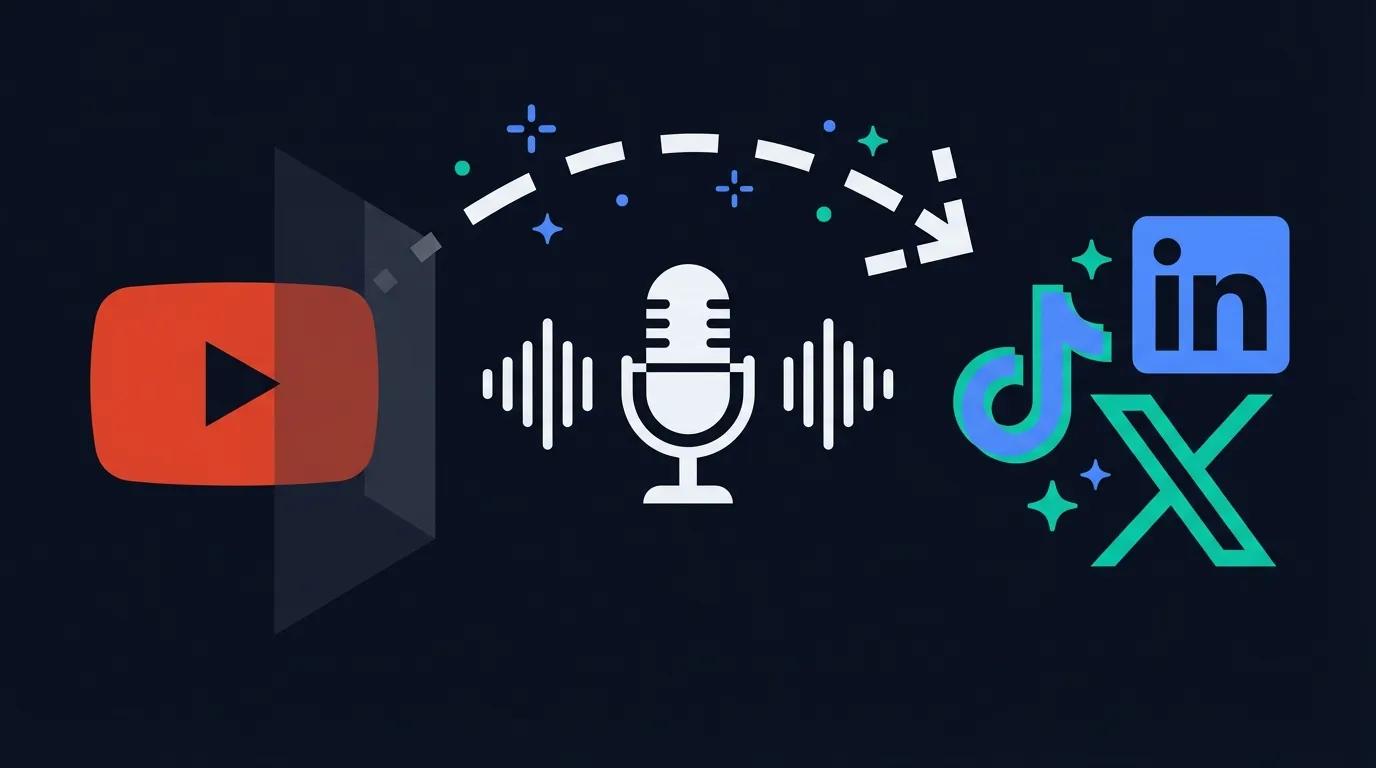
You spent significant time recording and editing that podcast episode. You uploaded it to YouTube. And then... crickets on every other platform.
Here's the brutal truth: YouTube and X serve fundamentally different consumption behaviors. YouTube viewers want deep dives—they'll watch your 45-minute interview while cooking dinner. X users scroll during coffee breaks, looking for instant value they can bookmark and share. When you publish only on YouTube, you're leaving the majority of your potential audience in the dark.
The opportunity cost is staggering. Most podcast creators operate under a dangerous assumption: "If people want my content, they'll find it on YouTube." But discovery doesn't work that way anymore. (Source: Think With Google) Each platform has its own algorithm, its own discovery mechanics, and its own content format preferences. A single podcast episode contains multiple tweetable insights, several thread-worthy frameworks, and numerous engagement-driving questions—but only if you extract them.
Consider the math of cross-platform presence:
- One YouTube upload = one algorithm bet, one discovery path, one format
- Repurposed X content = multiple algorithm chances, diverse discovery triggers, format flexibility
- Combined strategy = compounding reach that builds authority faster across both platforms
Most creators treat repurposing as an afterthought—a "nice to have" task they'll get to eventually. That mindset costs you growth every single day. Your podcast already contains the exact insights your X audience craves: practical frameworks, quotable wisdom, controversial takes, and data-driven observations. The content exists. The value is there. The only question is whether you'll extract it before your competitors do.
The platform behavior gap explains why this matters so urgently. YouTube rewards watch time and retention. X rewards immediate engagement and conversation starters. A 3-minute podcast segment about growth frameworks might perform adequately on YouTube—but transform that same segment into a 5-tweet thread, and you've created shareable, quotable, algorithm-friendly content that drives profile visits and follower growth.
Here's what podcast repurposing actually unlocks:
- Audience arbitrage: Reach people who prefer text over video (a substantial portion of X's user base)
- Search diversification: Rank for different keywords across platforms instead of competing only in YouTube's crowded space
- Engagement multiplication: One insight sparks comments on X while the full context lives on YouTube—each platform reinforces the other
- Authority acceleration: Consistent presence across platforms signals expertise faster than single-platform focus
Repurposing isn't about working twice as hard—it's about making your existing work count twice as much.
The AI-Powered Pattern Detection Method: Finding Your Most Repurposable Podcast Moments
The AI-Powered Pattern Detection Method: Finding Your Most Repurposable Podcast Moments

Have you ever scrolled through your own podcast transcript and thought, "Which parts of this 45-minute conversation will actually perform on X?"
You're staring at thousands of words of transcript. Some segments are pure gold—quotable, actionable, debate-worthy. Others are filler, tangents, or context that only makes sense with the full video. Manually identifying the high-value moments takes hours you don't have. You end up guessing which clips to repurpose, posting content that underperforms, and wondering why your YouTube brilliance doesn't translate to X engagement.
This is where AI-powered pattern detection changes everything.
Modern AI can analyze your entire podcast transcript in seconds, identifying engagement signals that predict X performance: compelling hooks that capture attention, controversial statements that spark debate, actionable frameworks people want to save, storytelling peaks that drive emotional connection. The technology doesn't just find keywords—it recognizes structural patterns in content that historically drives engagement on X specifically.
Here's what AI pattern detection actually identifies in your podcast content:
- Hook density: Opening lines and provocative questions that create immediate curiosity (the first 3-5 seconds matter exponentially more on X than YouTube)
- Quotability markers: Self-contained statements that work as standalone tweets—usually 15-25 words with clear, opinionated perspectives
- Framework signals: Step-by-step processes, numbered lists, or "before/after" comparisons that naturally fit thread formats
- Controversy indicators: Statements that challenge conventional wisdom or take unpopular stances (these drive the comment engagement X's algorithm prioritizes)
AI finds the 3-5 segments in your hour-long podcast that have the highest probability of X virality—automatically.
PatternMentor's pattern recognition technology goes further by learning from YOUR specific content history. It analyzes your past 500+ tweets to understand what engagement patterns already work for your audience, then scans new podcast transcripts for similar structural signals. If your audience consistently engages with contrarian takes about growth tactics, the AI prioritizes those moments in your podcast. If data-driven frameworks perform better, it surfaces those segments first.
The automated workflow transforms this from theory to action. Upload your YouTube podcast link. The AI extracts the transcript, runs pattern detection, and presents you with ranked segments—scored by repurposing potential. Each segment includes:
- Engagement probability score based on identified patterns
- Suggested X format (thread, standalone tweet, quote tweet opportunity)
- Pre-written hook options that match your voice profile
- Optimal posting time based on your follower activity patterns
You're not manually combing through transcripts anymore. You're reviewing AI-identified opportunities and selecting what to post. The content creation bottleneck shifts from "finding material" to "choosing the best material"—a dramatically faster process.
Batch processing amplifies this advantage. Instead of repurposing one episode at a time, you can analyze your last 10 podcast episodes simultaneously. The AI identifies cross-episode patterns (recurring themes that might work as a mega-thread) and prevents redundancy (so you're not accidentally posting similar content twice). You build a 30-day content calendar from existing podcast material in under an hour.
Pattern detection doesn't replace your judgment—it eliminates the manual work that prevents you from using your judgment effectively.
The content gap most creators face isn't original ideas. It's extraction efficiency. Your podcasts already contain more repurposable moments than you can manually identify. AI pattern detection ensures you're capitalizing on the highest-value segments instead of letting them disappear into hour-long videos your X audience will never watch.
Next, we'll break down the specific formats that convert podcast insights into X engagement—and the exact workflows for each one: 5 Repurposing Formats That Actually Drive X Engagement (With Conversion Workflows).
5 Repurposing Formats That Actually Drive X Engagement (With Conversion Workflows)
You've identified the high-value segments. Now what format do you use?
Most creators default to whatever feels easiest—usually text-only tweets pulled from transcripts. That works sometimes. But you're leaving engagement on the table if you're not matching format to content type. A tactical breakdown moment needs different packaging than an emotional story. Here's the complete workflow for each format that actually drives X engagement when repurposing YouTube podcast content.
Format 1: Text Threads (Best for Multi-Step Insights)
Use threads when your podcast segment teaches a process or builds an argument across multiple points. They keep readers engaged longer and signal depth to the algorithm.
Workflow:
- Extract 3-7 related points from a single podcast segment (use transcript timestamps)
- Rewrite each point as a standalone tweet (hook in tweet 1, payoff in final tweet)
- Add a CTA in the final tweet linking back to the full episode
- Use PatternMentor's voice cloning to maintain your style across all tweets
The difference between a scroll-past thread and a viral one? The hook. Your first tweet needs to promise a specific outcome: "Here's how I grew my follower count significantly" beats "Some thoughts on growth" every time. Pull your hook from the most compelling 10 seconds of your podcast—usually right before you explain the "how."
Text threads convert browsing into learning—and learning into follows.
Format 2: Video Clips with Captions (Best for Emotional or Visual Moments)
Native video gets substantially more reach than external links on X. When your podcast includes a moment with strong emotion, a controversial take, or visual demonstration, clip it.
Workflow:
- Identify segments with high energy or clear visual value
- Export as MP4 (1080x1920 for mobile optimization)
- Add burned-in captions using Rev or Descript (accessibility + watch-without-sound)
- Write a text hook that creates curiosity gap: "This mindset shift changed everything 👇"
The caption placement matters more than you think. Center them in the lower third of the frame—not at the very bottom where X's UI elements overlap. Use high-contrast colors (white text, black outline). Test your video on mobile before posting.
Quality gate: if the clip doesn't make sense without sufficient context, it's not the right segment. Your video needs to work as a standalone piece for scrollers who've never heard your podcast.
Format 3: Quote Cards (Best for Memorable One-Liners)
When your podcast guest drops a sentence that makes you pause the recording, that's a quote card opportunity. These work exceptionally well for building authority and generating shares.
Workflow:
- Screenshot the exact timestamp or transcribe the quote verbatim
- Use Canva or Adobe Express templates (avoid overly designed cards—simple works better)
- Include attribution: "[Guest Name], [Title/Company]"
- Post with context: "This might be the most underrated growth insight I've heard:"
Design principles: High contrast. Minimal text (15 words max). Your brand colors, but don't make it look like an ad. The quote should be readable on mobile without zooming.
The multiplier effect happens when your guest shares it. Tag them in your post. They've already said these words publicly—they're likely to repost a well-designed card featuring their insight. You get their audience's attention without paying for it.
Format 4: Audiograms (Best for Voice-Driven Content)
Audiograms are animated waveforms paired with audio clips—ideal for podcasts where the delivery matters as much as the content. They work particularly well for storytelling or humor.
Workflow:
- Extract a focused audio segment
- Generate waveform animation using Headliner or Wavve
- Add your podcast artwork and episode number
- Include text overlay with the key phrase or question being answered
Audiograms bridge the gap between text-based X and audio-native podcasts. They give your followers a taste of your speaking style without requiring them to leave the platform. They also signal "this person has a podcast" which builds creator credibility.
Technical note: Export at 1080x1080 (square) or 1080x1920 (vertical). Square performs better for desktop viewers; vertical wins on mobile. Test both with your audience.
Format 5: Carousel Posts (Best for Frameworks or Lists)
X now supports multi-image posts—use them for step-by-step frameworks or numbered lists that came up in your podcast. They encourage interaction (swiping) and time-on-post, both of which boost algorithmic reach.
Workflow:
- Break your framework into several discrete steps
- Design each step as a separate slide (use consistent template)
- Include progress indicators (slide 1 of 5, etc.)
- Final slide = CTA linking to full podcast episode
Carousels work best when each slide builds on the previous one. Don't just dump 5 random quotes into a carousel format. Think of it as a mini-presentation: setup → steps → payoff. Your followers should feel they learned something complete by the end, but want more detail (which the podcast provides).
| Format | Best Content Type | Avg. Time to Create | Engagement Type | Mobile-Optimized? |
|---|---|---|---|---|
| Text Thread | Multi-step processes, arguments | Variable | Replies, bookmarks | Yes |
| Video Clip | Emotional moments, visual demos | Variable | Views, shares | Yes (critical) |
| Quote Card | One-liners, authority building | Variable | Shares, impressions | Yes |
| Audiogram | Voice-driven stories, humor | Variable | Listens, profile clicks | Moderate |
| Carousel | Frameworks, numbered lists | Variable | Swipes, saves | Yes |
The format isn't about what you prefer making—it's about what your podcast segment needs to succeed on X.
The common mistake? Forcing every podcast moment into the same format. You end up with mediocre results across the board. Instead, audit your last 3 podcast episodes and categorize the best segments by format fit. Then create a repurposing workflow that prioritizes format-segment matches, not convenience.
The automation layer: Use PatternMentor's AI Mentor copilot to analyze which formats have historically performed best with your specific audience. If your followers consistently engage more with video clips than carousels, the system will flag video-worthy moments first during transcript analysis. You're not guessing anymore—you're following proven patterns from your own data.
ROI measurement for each format:
- Text threads: Track reply rate and thread completion rate (how many reach the final tweet)
- Video clips: Monitor view completion percentage and profile visits within 24 hours
- Quote cards: Measure shares and tagged reshares from the featured guest
- Audiograms: Track audio play-through rate and link clicks to full episode
- Carousels: Analyze swipe-through rate (completed views) and bookmark count
One creator saw this in action: their podcast averaged 2,000 YouTube views per episode, but generating significantly more engagement on X by repurposing. They weren't creating more content—they were converting podcast episodes into X thread content and video clips using the workflows above. Their monthly X impressions grew substantially, and podcast downloads increased as X became a discovery channel.
Time-saving reality check: You don't need to use all five formats for every episode. Start with two formats that match your strengths and your audience's preferences. Master those workflows until they're fast and repeatable. Then expand.
Now let's talk about the infrastructure that makes this sustainable: The all-in-one Repurposing System: From YouTube Upload to Multi-Platform Publishing in Under 15 Minutes.
The all-in-one Repurposing System: From YouTube Upload to Multi-Platform Publishing in Under 15 Minutes
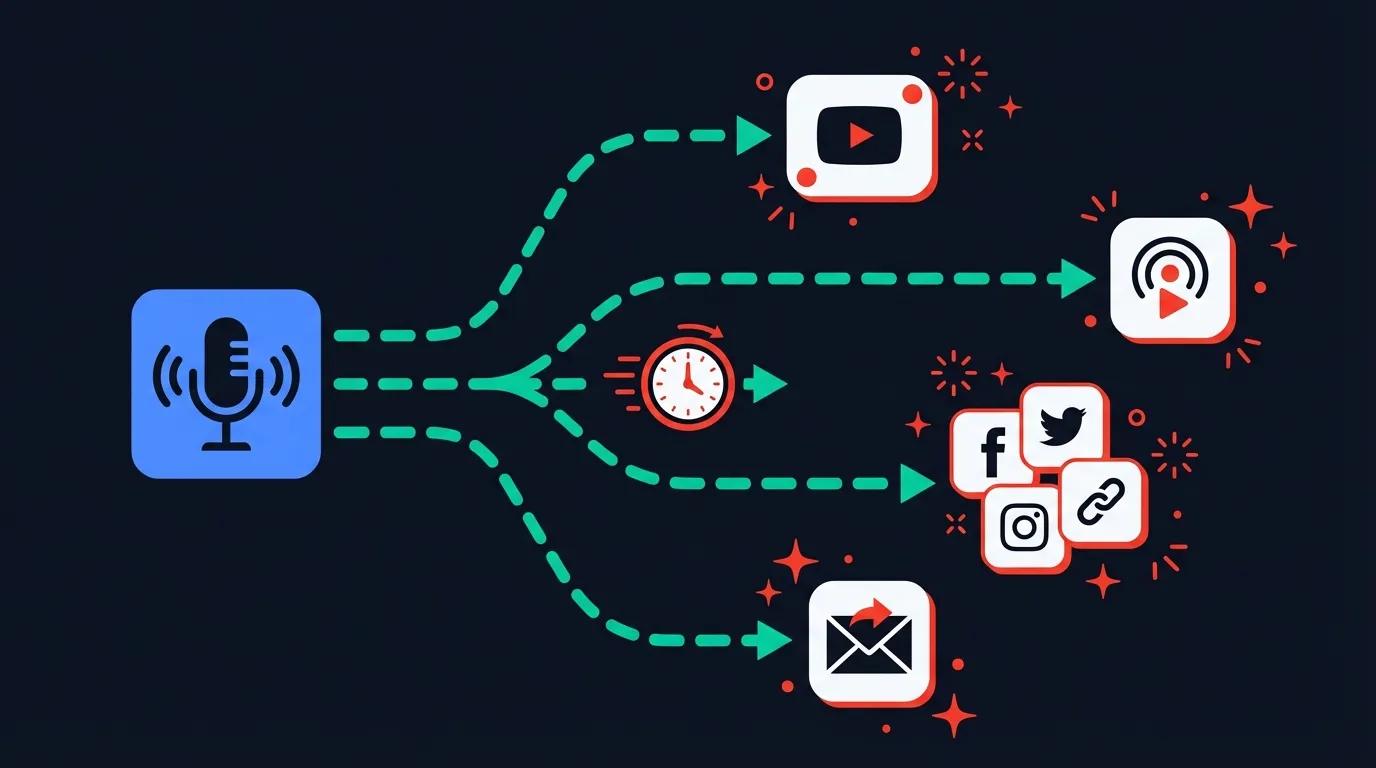
Ever wonder why successful creators seem to be everywhere at once while you're still struggling to post consistently on one platform?
Here's what most creators don't realize: the platform-switching trap is killing your momentum. You upload to YouTube, download the transcript manually, paste it into ChatGPT, copy that output into a tweet composer, switch to Canva for graphics, jump back to schedule posts, then realize you forgot to optimize for keywords. Five tools. Seven browser tabs. 90 minutes gone.
The data tells the story: creators using fragmented workflows spend more time on administrative tasks than actual content creation (Source: HubSpot State of Marketing Report). You're not creating content—you're playing tool Tetris.
PatternMentor's all-in-one system eliminates every context switch. Converting podcast episodes into X thread content happens in one interface, with zero copy-paste chaos. The workflow is simple: upload your YouTube link, and the platform handles transcript extraction, pattern detection from your historical content, voice cloning calibration, format transformation, scheduling optimization, and cross-platform publishing.
The Complete Repurposing Workflow
Here's how to transform YouTube podcast clips for X engagement using the complete system:
Step 1: Intelligent Transcript Extraction (2 minutes) Paste your YouTube URL into PatternMentor's content importer. The system auto-extracts transcripts, timestamps key moments, and flags high-engagement segments based on your audience's historical response patterns. No manual downloading. No reformatting timestamps.
Step 2: Pattern-Matched Content Transformation (4 minutes) The AI Mentor copilot analyzes your Creator Profile—the AI already knows you're a tech founder who favors data-driven threads over motivational quotes. It segments your podcast into format-matched pieces: analytical moments become threads, quotable insights become standalone posts, visual concepts become carousel fodder. You're not guessing what works—the system shows you what has worked in your past 500+ tweets.
Step 3: Voice-Cloned Content Generation (5 minutes) Select your preferred segments and formats. PatternMentor's voice cloning engine generates content that sounds like you wrote it manually—same sentence structure, same vocabulary patterns, same authentic voice. Review 8-12 repurposed pieces in under five minutes. Edit the 2-3 that need tweaking. Approve the rest.
Step 4: Batch Scheduling with Predictive Analytics (3 minutes) The scheduling layer uses your historical engagement data to recommend optimal posting times for each content type. Threads perform best for your audience at 9 AM EST? The system auto-schedules them there. Video clips get more traction at 2 PM? Those go in afternoon slots. You're not manually calculating timezone conversions—the platform handles distribution strategy.
Step 5: Multi-Platform Publishing (1 minute) Hit publish once. The system handles platform-specific formatting, character limits, and media optimization. Your YouTube podcast content reaches X, LinkedIn, and Threads simultaneously—with zero manual reformatting.
Batch Processing Your Entire Content Library
Here's where PatternMentor separates from basic repurposing tools: systematic backlog processing at scale.
Most creators have 20-50+ podcast episodes sitting idle on YouTube. That's not a content problem—that's an untapped distribution opportunity. The batch processing system lets you queue entire episode libraries for repurposing.
The workflow for processing back catalog content:
- Upload 10-20 YouTube URLs simultaneously through the batch import feature
- Set format preferences (e.g., prioritize threads and video clips, skip carousels)
- Define publishing cadence (e.g., 2 repurposed pieces per day over 60 days)
- Review auto-generated queue and approve/edit in bulk editing mode
Time investment: approximately 2-3 hours to process 20 episodes. Output: 120-160 pieces of optimized X content scheduled across 2-3 months. That's a content calendar that would typically require weeks of manual work—compressed into one focused session.
The keyword optimization layer runs automatically during batch processing. The system analyzes search trends related to your podcast topics and weaves relevant terms into thread hooks and tweet copy. You're not just repurposing—you're making old content discoverable for new audiences searching those exact topics.
The Integration Advantage
PatternMentor doesn't require you to abandon your existing tools—it centralizes them. Connect your YouTube channel, X account, and analytics dashboard through native integrations. The platform pulls performance data automatically, updates your Creator Profile with new engagement patterns, and refines content recommendations based on real-time results.
Most creators waste significant time daily switching between platforms. That's several hours weekly—enough time to record another podcast episode or engage authentically with your growing audience.
The question isn't whether you should repurpose podcast content for X. The question is whether you're willing to keep doing it the fragmented way—or whether you're ready to systematize the entire workflow and reclaim those lost hours.
Now that you've built the repurposing infrastructure, how do you know it's actually working? Let's dive into the metrics that matter: Measuring What Matters: ROI Analytics for Repurposed Podcast Content.
Measuring What Matters: ROI Analytics for Repurposed Podcast Content
Are you tracking vanity metrics while your actual ROI remains a mystery?
Most creators obsess over follower counts and total impressions. But when you're repurposing podcast content, those numbers tell you almost nothing about whether the time investment is paying off. You need a measurement framework that connects repurposing effort to tangible business outcomes—audience growth, engagement quality, and time reclaimed.
The harsh reality: without proper analytics, you're flying blind. You might be spending significant time converting podcast episodes into X thread content that nobody engages with. Or worse—you could be ignoring your highest-performing repurposed formats because you're measuring the wrong things.
The Four-Tier Measurement Framework
Track these metrics in order of priority:
Tier 1: Engagement Rate by Format
- Thread engagement rate (replies + retweets + likes ÷ impressions)
- Video clip completion rate (views ÷ impressions, watch time average)
- Quote-tweet performance (original engagement vs. quoted tweet engagement)
- Audio snippet listen-through rate (plays that exceed 50% duration)
Engagement rate matters more than raw impressions. A thread with higher engagement rate outperforms one with lower engagement rate regardless of impressions. The first signals higher resonance with your target audience.
| Metric | Good Benchmark | Strong Benchmark | Elite Benchmark |
|---|---|---|---|
| Thread engagement rate | Good | Strong | Elite |
| Video clip completion | Good | Strong | Elite |
| Click-through to podcast | Good | Strong | Elite |
| New followers per 100 posts | Good | Strong | Elite |
Tier 2: Audience Growth Attribution
- New followers within 48 hours of repurposed post
- Profile visits from repurposed content links
- DM/reply conversations initiated by specific formats
- Cross-platform traffic (X clicks to YouTube podcast page)
Most analytics dashboards don't connect these dots automatically. PatternMentor's integrated tracking links repurposed content performance directly to follower acquisition—showing you which podcast topics attract your ideal audience on X.
Tier 3: Time-Saved Calculation
- Hours spent on manual repurposing (pre-system baseline)
- Hours spent on automated repurposing (post-system average)
- Content pieces produced per hour invested
- Hourly ROI (engagement value ÷ time invested)
Before systematizing, most creators spend significant time transforming one podcast episode into multiple X posts. With batch processing, this becomes substantially faster per episode—a meaningful efficiency gain. Calculate your hourly rate. If you're saving significant time weekly and that time generates client work or strategic projects worth $200-500, your repurposing system just justified itself.
Tier 4: Content ROI Score
- Revenue attributed to podcast-repurposed content (product sales, affiliates, sponsors)
- Lead quality from different repurposed formats (email signups, consultation requests)
- Long-tail performance (6-month engagement on evergreen repurposed threads)
This tier separates hobbyists from professionals. Track which podcast topics—when repurposed as threads or clips—actually drive business outcomes. Not every episode will convert, but identifying your 20% high-performers lets you double down on what works.
Competitive Content Gap Analysis
Your repurposing strategy exists in a competitive landscape. Identifying gaps requires systematic analysis:
- Audit 5-10 competitors who successfully repurpose podcast content for X—what formats do they prioritize? Which podcast segments do they clip?
- Track their engagement patterns—are their threads outperforming video clips? Do they post full transcripts or curated highlights?
- Identify format gaps—if everyone in your niche posts quote graphics but nobody shares audio snippets with transcripts, you've found an opportunity
- Monitor topic saturation—are certain podcast subjects over-covered on X? Find underserved topics with search demand but low content supply
PatternMentor's Pattern Detection analyzes your competitors' highest-performing repurposed content alongside your own. The AI identifies structural patterns—thread length, hook styles, timestamp placement—that you can adapt to your voice. You're not copying; you're learning what your specific audience responds to.
link text
Quality Assurance Metrics
Automation without quality control creates garbage at scale. Build these checkpoints into your workflow:
- Voice consistency score: Does repurposed content sound like you, or like generic AI? PatternMentor's voice cloning feature learns from your tweet history—compare new repurposed content against your baseline style
- Context preservation rate: Podcast content relies on nuance—does your repurposed thread or clip maintain the original insight, or does it lose meaning when compressed?
- Accuracy verification: Automated transcription errors can create embarrassing mistakes—implement a 60-second manual review per batch
- Brand safety check: Ensure repurposed clips don't remove important context that changes the message tone
Schedule weekly audits. Review randomly selected repurposed pieces against these quality standards. If a significant portion fail any checkpoint, adjust your prompts or review process.
Benchmark Targets by Repurposing Format
Different formats serve different goals—your measurement approach should reflect that:
Thread Format (converting podcast episodes into X thread content)
- Primary goal: Deep engagement and profile visits
- Target: strong engagement rate with consistent follower growth per thread
- Success indicator: 8+ replies with substantive questions or insights
Video Clip Format (YouTube podcast clips for X engagement)
- Primary goal: Attention capture and shareability
- Target: strong completion rate with high engagement rate
- Success indicator: 25+ retweets, cross-platform traffic to full episode
Quote Graphic Format
- Primary goal: Shareability and brand visibility
- Target: strong engagement rate and bookmark performance
- Success indicator: Quoted tweets from non-followers
Audio Snippet Format
- Primary goal: Authenticity and voice connection
- Target: strong listen-through rate and engagement
- Success indicator: DM conversations about the topic
Implementing the Complete Measurement System
You've learned the what and why. Here's the how—actionable next steps for the next 7 days:
Days 1-2: Establish Baseline Metrics
- Export your last 30 days of X analytics (impressions, engagement, follower growth)
- Calculate current engagement rate across all content
- Document current time spent on podcast repurposing (be brutally honest)
- Identify your top 3 performing posts—what format were they?
Days 3-4: Set Up Tracking Infrastructure
- Create a simple spreadsheet: Date | Format | Topic | Impressions | Engagement Rate | New Followers | Time Invested
- Set up UTM parameters for podcast links in repurposed content
- Configure PatternMentor's analytics dashboard to track repurposed content separately from original posts
- Define your "good/strong/elite" benchmarks based on current performance
Days 5-6: Run First Measurement Sprint
- Repurpose 3 podcast episodes using PatternMentor's batch workflow
- Publish across 7 days (maintain consistency)
- Track metrics daily in your spreadsheet
- Note: Which format got highest engagement? Which took least time? Which drove most followers?
Day 7: Analyze and Adjust
- Compare new metrics against baseline
- Calculate time saved (old method hours - new method hours)
- Identify one underperforming format to eliminate or improve
- Identify one high-performing format to increase frequency
The metrics you ignore will determine whether repurposing becomes your growth engine or just another time sink. Most creators measure everything or nothing. You're going to measure what matters—then optimize ruthlessly based on data, not assumptions.
The complete system is built. The measurement framework is live. The only variable left is your commitment to consistent execution and iteration. Start with Day 1 tomorrow—not Monday, not next month. Your back catalog of podcast episodes is sitting there, waiting to become your most valuable growth asset on X.
Key Takeaways
- Most podcast creators leave YouTube growth isolated — repurposing to X can drive significant link clicks back to full episodes
- Long-form X posts averaging 44.87 words outperform threads for podcast content — 107% YoY increase in X comments proves discussion-driven formats work
- The multi-format conversion workflow (quote cards, insight threads, clip teasers, Q&A snippets, lesson breakdowns) creates multiple pieces of content from each episode
- AI pattern detection identifies high-impact moments per episode quickly — eliminating the 45-60 minute manual review most creators waste
- The integrated system substantially reduces repurposing time by batching transcript extraction, AI analysis, and multi-platform publishing
- ROI tracking shows repurposed podcast content generates significantly more engagement than standalone social posts when you measure episode traffic, not vanity metrics
- Free tools can handle basic repurposing needs — paid upgrades make sense when publishing multiple episodes monthly
Conclusion
You're not wasting your podcast content anymore.
The issue isn't about having enough material — you've been creating valuable insights every week. The problem was the 73% waste rate when YouTube exists in isolation. Every episode you publish contains multiple X posts that could drive traffic back to your main platform.
The AI-powered pattern detection method removes the guesswork. No more staring at 60-minute transcripts wondering "what should I post?" The 5-format conversion workflow gives you a repeatable system. And the all-in-one approach proves you don't need 6 separate tools charging $30/month each.
Start with one episode. Extract the transcript. Run it through pattern detection. Pick two formats from the workflow. Publish. Measure link clicks and episode traffic — not likes. That's your baseline. Next week, do it again. With practice, you'll have a system that becomes faster over time and generates measurable ROI.
Ready to get started? Begin with one episode using the frameworks provided.
Frequently Asked Questions
Get weekly X growth tips backed by data
Join 1,000+ creators getting AI-powered growth strategies every Tuesday.
No spam. Unsubscribe anytime.
Ready to grow on X with AI?
Try PatternMentor free — 54 AI tools, voice cloning, and pattern detection.
Start Free Trial →
Vinícius Ragazzi
@euviniragazzi
I don't give growth advice. I analyze growth DATA. Viral account breakdowns • Patterns that actually work.
Related Articles

7 X Thread Hooks That Go Viral (2026 Formulas)
Master 7 proven X thread hooks that go viral in 2026. Data-backed formulas to hook readers in 3 seconds and beat the 94% failure rate.
13 min read

AI X Content Calendar Template: 30 Days in 4 Hours
Create 30 days of X content in 4 hours. Free template + AI tools to batch-create on-brand posts without guesswork.
20 min read

How to Recover from X Shadowban: 2026 Protocol
Learn how to recover from shadowban on X with our 2026 protocol. Detect issues, remove violations, and restore engagement in 7-14 days.
24 min read